Squares and streets within the same few blocks
Old Town around the Dom
A half-day around the Salzburg Cathedral midday concert: the squares, the abbey, the Franciscan church and nearby streets, without distances or hours.
Reserve a seat under the dome ↗Before the concert
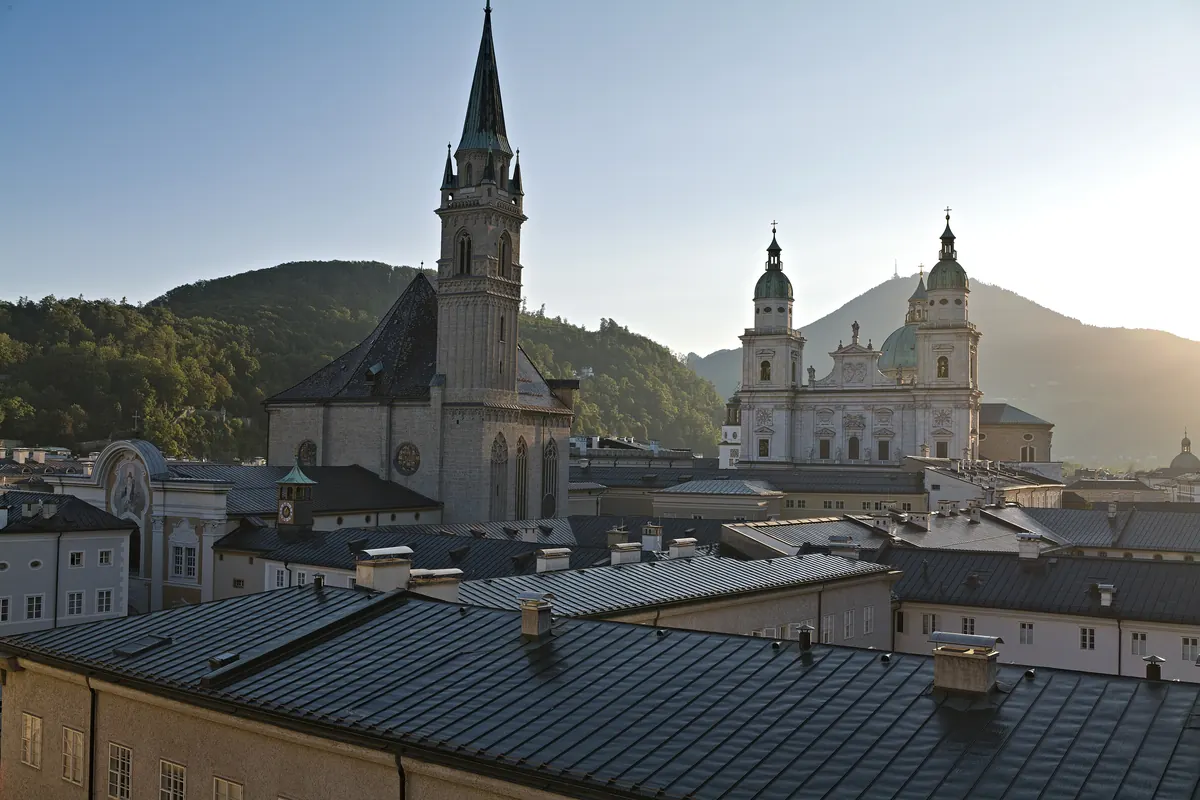
English Wikipedia says the cathedral stands beside Residenzplatz and Domplatz in the Old Town. The historic centre of Salzburg has held UNESCO World Heritage status since 1996, and Wikipedia lists the squares, churches and streets within its core zone. Spend the morning in the squares, and be at Domplatz in good time, because the concert begins after the bells. Check opening times for any museum on the day, as this guide gives none, and leave a margin before the concert so that the bells are a cue rather than a deadline.
Residenzplatz and the Residenz
Wikipedia lists the Residenzplatz as a large square outside the Residenz, with a large and ornate fountain, and the Residenz as the former residence of the Prince-Archbishops of Salzburg, which houses the Residenzgalerie art gallery. German Wikipedia says the demolition of the old cathedral made room for the Residenzplatz, the square on the north side of the new one. The Residenz is joined to the cathedral on Domplatz by the cathedral arches.
Kapitelplatz and St Peter's Abbey
The cathedral's history page says the demolition after the 1598 fire also destroyed the monastery south of the Romanesque cathedral, leaving space for a square, today's Kapitelplatz. English Wikipedia lists St Peter's Abbey as a Benedictine monastery founded in 696 with a well-known cemetery, and says the cathedral arches join the cathedral with the abbey around Domplatz.
The Franciscan church
Wikipedia lists the Franciscan church, Franziskanerkirche, as one of Salzburg's oldest buildings, dating from 1208 and used by the Franciscans since 1642. German Wikipedia adds that from the Franciscan church the view of Domplatz creates a play of perspective, in which two angels on the cathedral front crown the head of Mary on the column.
Getreidegasse and Mozartplatz
Wikipedia lists Getreidegasse as a busy narrow shopping street with numerous high townhouses, and Mozartplatz as a historic square with a monument to Mozart. Both are in the core zone of the Old Town. After the concert, they make a natural walk through the core of the Old Town, and this guide recommends no restaurant by name.
The festival halls and the cathedral's quarry
English Wikipedia lists the Felsenreitschule as an open-air theatre built in the quarry that was used for the construction of Salzburg Cathedral. It lists the Großes Festspielhaus, an opera house and concert hall dating from 1960 and built for the annual Salzburg Festival, and the Haus für Mozart, formerly the Kleines Festspielhaus, dating from 1925. They are further places in the core zone where Salzburg's music can be heard, and each has its own calendar.
After the concert
Keep the afternoon free of fixed times, since the Old Town is best on foot. On the home page, the second card is a separate entry ticket for the cathedral, with an optional audio guide. If you want the building at your own pace after the recital, that is the ticket for it, and the audio guide offers a classic tour, a short tour and a children's tour.
Read next: Salzburg organ concert
Frequently asked questions
Is the cathedral in the Old Town?
Yes. English Wikipedia says it stands beside Residenzplatz and Domplatz in the Altstadt.
Does the Old Town have UNESCO status?
Yes. Wikipedia says the Old Town has held UNESCO World Heritage status since 1996.
Does this guide list opening hours?
No. Hours and tickets for museums, churches and halls change, so check each place's own page for the day you go.
Which squares join the cathedral?
Domplatz and Residenzplatz, according to English Wikipedia, which says the cathedral stands beside both.
Sources